+84 9 75 46 33 10 (Whatsapp)
  info@horizon-vietnamtravel.com
  Français
  Español
  Português
  Deutsch

The Cult of Fertility in Vietnam
Table of contents
At the heart of Vietnamese culture, the cult of fertility (tín ngưỡng phồn thực) has occupied a central place for millennia. Closely linked to the civilization of irrigated rice, it expresses the essential aspirations of rural communities: to live in harmony with nature, ensure abundant harvests and guarantee the continuity of the lineage.
At Horizon Vietnam, we consider this ancestral cult as a precious key to better understand the history and traditions of the country. To take an interest in these rites is to enter a vision of the world where yin and yang complement each other to give birth to life and prosperity.
What is the Cult of Fertility?
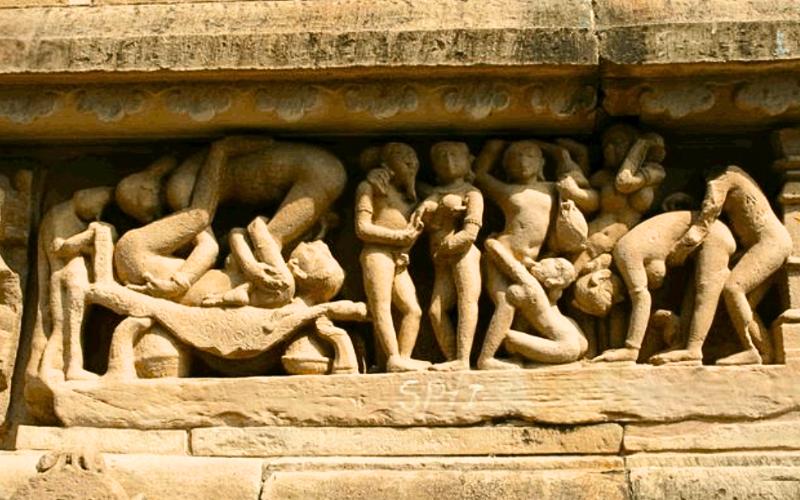
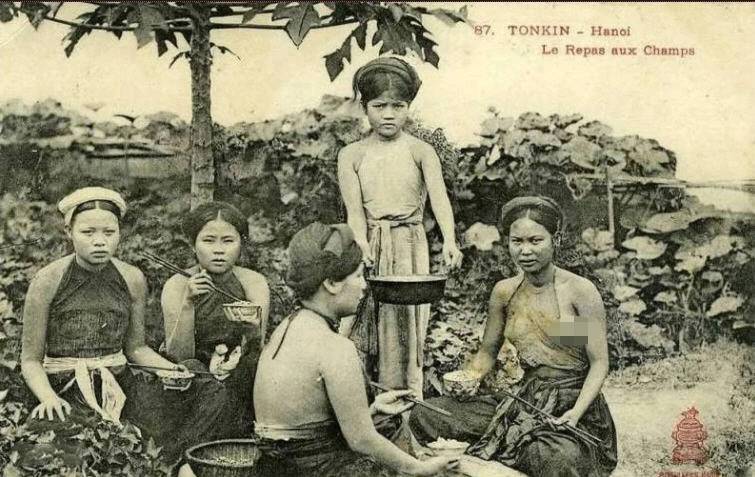
In ancient Vietnam, life was based on two essential needs: producing rice to survive and reproducing to ensure the future of the village. Rice-growing society saw yin (feminine) and yang (masculine) as two opposing but complementary forces, whose union gave birth to life, growth and abundance.
It is from this harmonious conception of nature that the cult of fertility was born, a belief that still occupies an important place in Vietnamese culture and traditions today.
Origins of the Cult of Fertility
The cult of fertility (tín ngưỡng phồn thực) has occupied a fundamental place in Vietnamese culture for millennia. To understand the importance of this belief today, we must go back to its deep origins, to the time when the first communities lived essentially from agriculture and rice cultivation.
In these ancient societies, survival depended on two essential conditions:
- having fertile land to ensure abundant harvests,
- and ensuring the multiplication of the human lineage to maintain and develop the community.
It is in this context that the first forms of the cult of fertility in Vietnam emerged.
The most perceptive spirits interpreted natural phenomena through cycles, balances and laws, giving rise to the philosophy of yin and yang, a major axis of Asian thought.
The people, for their part, saw in the power of nature – that which makes plants grow, animals be born and humans grow – a sacred force. This mysterious force, linked to reproduction and abundance, was gradually venerated, giving birth to phồn thực:
- phồn: abundance
- thực: growth, multiplication
Thus was born a set of rites and symbols centered on fertility, perceived not only as a biological phenomenon, but as a vital energy, source of prosperity and renewal.
The phồn thực cult expresses itself mainly in two forms:
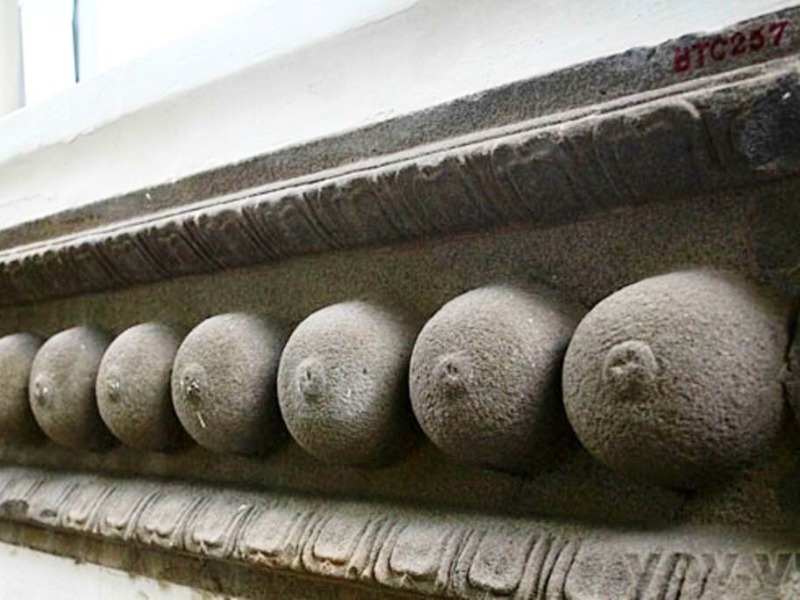
- the veneration of male and female sexual organs, direct symbols of reproduction,
- and the celebration of the sexual act, considered as the perfect union of yin and yang, of heaven and earth, of man and woman.
Contrary to a common misconception, this cult has nothing vulgar about it: it represents a positive and harmonious vision of the world. It is a cultural tradition rather than a religion, widely shared by many agricultural societies in Southeast Asia and beyond.
For ancient peoples, the sacred energy present in nature could be transmitted to humans, animals, plants and the environment. This intuitive belief gave rise to varied practices, from symbolic objects to village ceremonies, which still testify today to the importance of the cult of fertility in Vietnamese culture.
Symbolism Inscribed in Vietnamese Architecture
Many emblematic monuments of Vietnam bear a yin-yang symbolism directly linked to the cult of fertility, sometimes in such a subtle manner that it goes unnoticed at first glance.
- The One Pillar Pagoda (Hanoi) is the most telling example. Its single, vertical pillar embodies the yang (masculine principle), while the square basin that surrounds it represents the yin (feminine principle). Together, they form a powerful image of creative union.
- At the entrance to the Ngọc Sơn Temple, the Brush Tower (Tháp Bút) and the Inkwell (Đài Nghiên) appear as two complementary forms. The slender brush symbolizes the masculine, the curved inkwell evokes the feminine: a duo that points to harmony, knowledge… and fertility.
- At the Temple of Literature (Văn Miếu), the famous round window of the Khuê Văn Pavilion, associated with the Khuê star and the yang principle, is reflected in the square Thiên Quang Tỉnh basin, a symbol of yin. This dialogue between the round and the square, between heaven and earth, illustrates the fundamental balance of yin and yang.
- At the Vietnam Ethnography Museum, traditional houses, funerary statues and ritual objects on display shed light on the constant presence of the phồn thực cult. Columns evoking masculine energy, natural cavities symbolizing the feminine, scenes carved depicting reproduction… everything testifies to the importance of this belief in ethnic cultures.
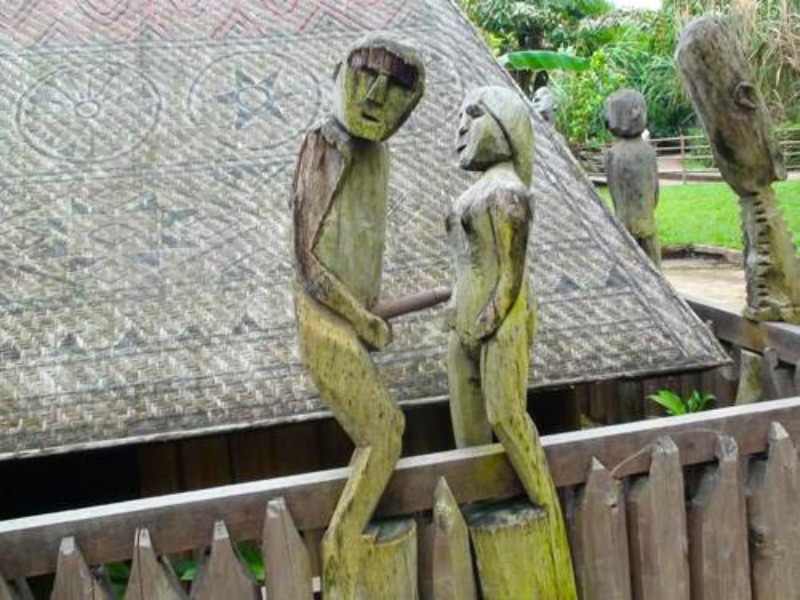
Nothing is left to chance: whether it is architecture or everyday objects, the complementarity of the round and the square, the vertical and the horizontal, of yin and yang, expresses a vision of the world in which the union of opposites gives birth to life. This profound harmony remains at the heart of the Vietnamese fertility cult, passed down from generation to generation.
Fertility Festivals in Vietnam
Vietnam preserves many traditional festivals where fertility, the union of yin and yang and wishes for prosperity occupy a central place. These ancestral celebrations, sometimes astonishing, testify to how the Vietnamese once honored the forces of nature and hoped for good harvests.
The “Linh Tinh Tình Phộc” Festival (Phu Tho)
Also called the Trò Trám festival, the “Linh tinh tình phộc” ceremony is one of the oldest fertility festivals in Vietnam. It takes place on the 11th and 12th of the first lunar month in the commune of Tứ Xã, district of Lâm Thao, province of Phú Thọ.
The most striking moment is the secret ritual celebrated at midnight, at the symbolic moment of transition between the night of the 11th and the dawn of the 12th, considered a time of meeting between heaven and earth.
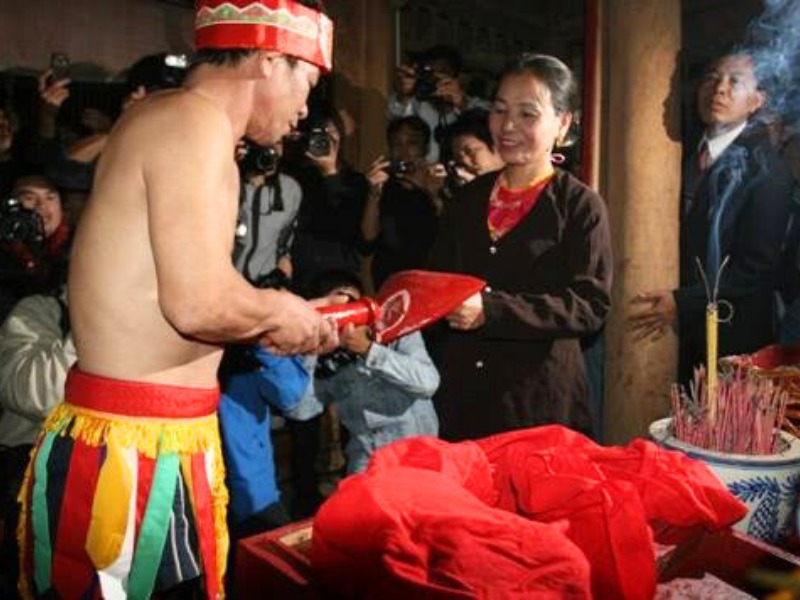
When the temple lights are extinguished, the master of ceremonies pronounces the invocation “linh tinh tình phộc”. At this signal, a married couple, chosen in advance, performs gestures symbolizing the sexual act, a ritual embodiment of the union of yin and yang.
The number of “successes” of the gesture is interpreted as a sign for the agricultural season:
- three successes: a year of abundant harvests,
- two successes: a good season,
- one success only: a less favorable year.
This rite, steeped in spirituality and symbolism, reflects the wish for fertility, prosperity and renewal for the community.
The Na Nhem Festival (Lang Son)
The Na Nhem festival, celebrated on the 15th of the first lunar month, is one of the most singular traditions of the Tày people in the mountainous province of Lang Son. This celebration pays homage to King Mạc Thái Tổ and is distinguished by an atypical ritual highlighting two symbolic offerings: the tang thinh, representing the masculine principle, and the mat nguyet, symbolizing the feminine principle.
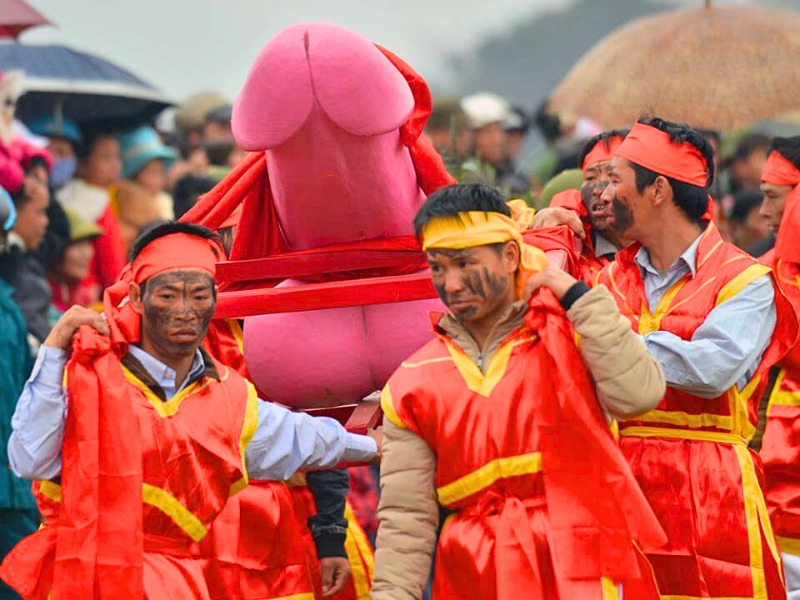
Na Nhem
These ritual objects, inherited from a long tradition linked to the cult of fertility, embody wishes for prosperity, fertility and the continuity of the lineage. Although unusual to the modern eye, this ritual testifies to an ancient vision where the union of complementary forces of yin and yang was considered essential to the renewal of the community.
The Ông Đùng Bà Đà Festival (Thai Binh)
Celebrated every year on the 14th lunar month at the Temple of the Lady of Salt, the Ông Đùng Bà Đà festival is a traditional ritual deeply marked by the cult of fertility. It stages the symbolic union of “Ông Đùng” and “Bà Đà,” two figures representing the masculine and feminine principles. Through this ceremony, the inhabitants express their wishes for prosperity, fertility and abundance for the year to come, thus perpetuating an ancestral belief centered on harmony and renewal.
The Đồng Kỵ Village Festival (Bac Ninh)
Each 6th day of the first lunar month, the village of Đồng Kỵ organizes one of the most emblematic processions linked to the cult of fertility. During the festival, two large wooden symbols representing the male and female sexual organs are carried in procession through the village. At the end of the ritual, these sacred objects are burned, and the ashes are then distributed among the inhabitants, who disperse them in their fields to attract luck, fertility and good harvests. According to local tradition, omitting this ritual would be a bad omen and could bring misfortune or poor seasons to the village.
Traditional Dishes Symbolizing Fertility
Among the many expressions of the cult of fertility in Vietnam, certain traditional dishes occupy a surprisingly symbolic place.
The bánh tét, a traditional cylindrical cake from the Central and South of Vietnam, is closely linked to an ancient symbolism of fertility. Once sliced, its mung bean and fatty meat core appears clearly, evoking the seed, vitality and abundance. Often considered the ancestor of bánh chưng, the bánh tét reflects the agricultural beliefs of old, founded on the fertility of the earth, the cycle of renewal and the hope of a prosperous year.
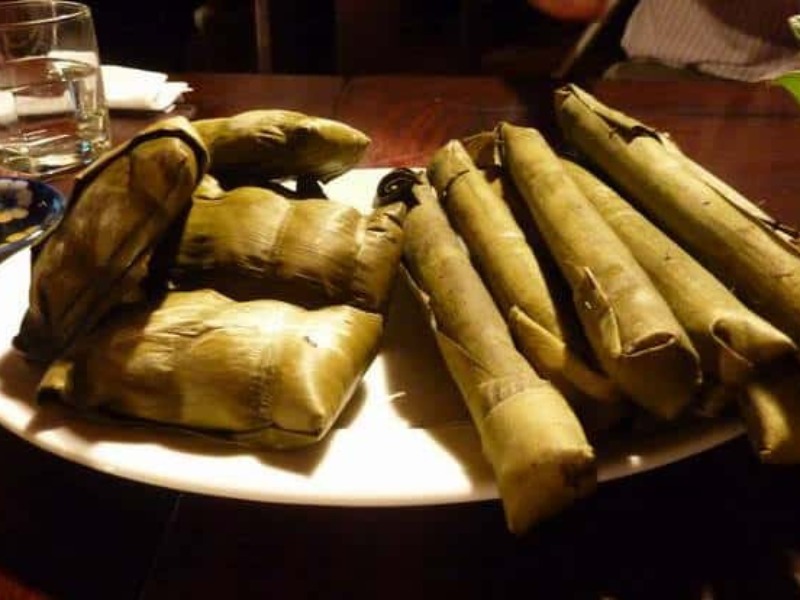
The bánh cúng and bánh cấp of the Chams represent one of the most explicit expressions of the cult of fertility in Vietnam. Entirely made from sticky rice – a central ingredient in Cham ritual gastronomy – these cakes carry strong symbolism based on the complementarity of the masculine and feminine. The bánh cúng, long and slender, refers to the Linga, a symbol of the masculine principle, while the bánh cấp, rectangular in shape, evokes the Yoni, associated with feminine energy.
Traditionally consumed together, these two cakes embody the sacred union at the origin of life and prosperity. In Cham culture, their form and ritual use directly reflect ancestral beliefs linked to fertility, renewal and the balance of yin and yang. They remind us that, in traditional thinking, all creation rests on harmony between the complementary forces of the masculine and feminine.
Through its rites, its festivals and its very ancient symbols, the cult of fertility sheds light on an essential part of Vietnamese culture. This tradition, inherited from a long agricultural past, expresses above all the desire for harmony, renewal and prosperity. Whether through popular ceremonies, motifs present in architecture or ritual dishes, all these manifestations recall the importance given to the balance between the forces of nature. Today, this heritage continues to live and accompany Vietnamese communities, testifying to the richness and continuity of their beliefs.