+84 9 75 46 33 10 (Whatsapp)
  info@horizon-vietnamtravel.com
  Français
  Español
  Português
  Deutsch

Ancient Vietnamese Currency: Legacy of a Rich Past
Table of contents
Ancient Vietnamese currency represents an exceptional heritage, bearing witness to imperial dynasties, commercial exchanges, and cultural influences that shaped Vietnam through the centuries. Far more than simple tools of exchange, these coins and banknotes tell a story in which art, power, and traditions interweave. Exploring this fascinating universe, one perceives the traces of time and the ingenuity of a people who has known how to preserve its own identity through the ages. Let us set out to discover this historical treasure, a true bridge between the past and the living culture of Vietnam today.
During the Era of King Dinh Bo Linh (968)
Ancient Vietnamese currency finds its origins under the reign of King Dinh Bo Linh, in 968, founder of the first centralized State of Dai Viet. This visionary sovereign, after more than a thousand years of Chinese domination, laid the foundations of an independent monarchy and asserted the sovereignty of nascent Vietnam. Among the great reforms of his reign, the introduction of a Vietnamese national currency marked a fundamental symbolic milestone in the history of the country.
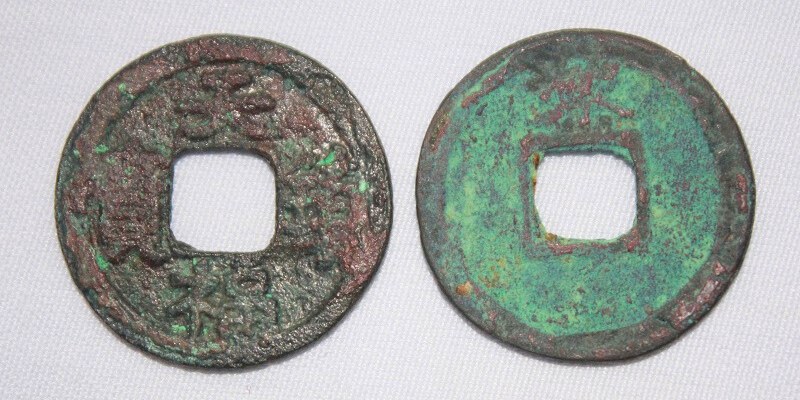
Currency during the era of King Dinh Bo Linh (968)
This first official currency, named “Thai Binh Hung Bao” – meaning Restored Peace – bore Chinese characters, in direct reference to the reign name of the Dinh dynasty. Cast in bronze, the coin presented a round form perforated by a square hole at the center, a symbol according to Eastern cosmology of heaven (round) and earth (square). This conception reflects not only Asian spirituality, but also the harmony between imperial power and universal order. Three variants of this first Vietnamese currency could be distinguished:
- without the character “Dinh”;
- with the character “Dinh” on the square hole;
- with the character “Dinh” below the square hole.
These differences testify to the artistic wealth and the political will of King Dinh Bo Linh to create a strong symbol of Vietnamese identity, marking the beginning of a monetary tradition national that would endure through the centuries.
Under the Earlier Lê Dynasty (10th Century)
Under the Earlier Lê dynasty, in the 10th century, Vietnam continued the development of its national currency while consolidating its own independence. The imperial court, installed in Hoa Lu in the present-day province of Ninh Binh, had a new currency minted that bore the name “Thien Phuc,” meaning “Grace of Heaven.”
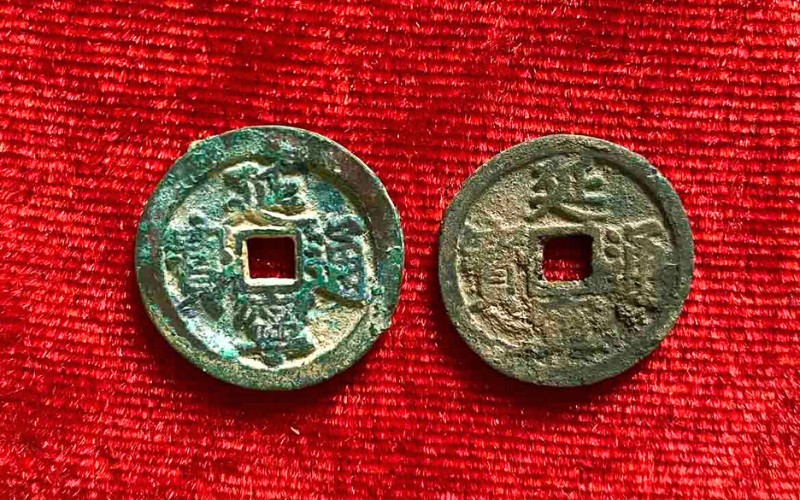
Currency under the Earlier Lê dynasty (10th Century)
This ancient Vietnamese currency preserved the circular form with a square hole at the center, symbolizing the union between heaven and earth according to Eastern thought. However, a remarkable innovation appeared: Chinese characters were engraved on both sides of the coin, a first in the monetary history of Vietnam. This subtle evolution illustrates the will of the Lê sovereigns to preserve the Vietnamese monetary identity inherited from the Dinh, while bringing to it a touch of elegance and originality. It thus marks the continuity of a tradition that unites aesthetics, spirituality, and sovereignty.
Under the Hồ Dynasty (14th Century)
In 1396, the rise to the throne of the Hồ dynasty ended the reign of the Tran and opened a new page in Vietnamese monetary history. Under King Hồ Quý Ly, Vietnam experienced a true economic revolution: for the first time, a paper currency was issued, marking an important innovation in the region.
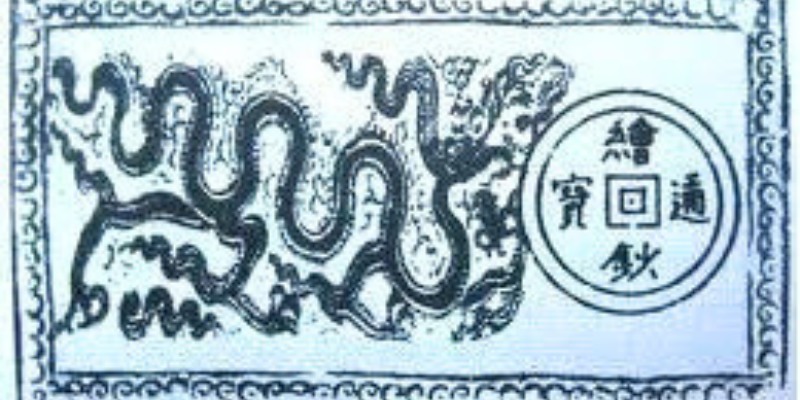
Currency Thong Bao Hoi Sao – first Vietnamese paper currency, issued in 1396 under the reign of King Hồ Quý Ly marking a bold reform
Visionary and reformer, Hồ Quý Ly wished to modernize the national economy and reduce dependence on metal. He prohibited the use of metallic currency in order to impose the new banknotes, hoping thus to strengthen State control over monetary circulation.
However, this radical reform, implemented too rapidly, met with strong popular resistance and caused economic imbalances. Faced with its failure, and after the fall of the Hồ, the Lê dynasty reestablished metallic currency as early as 1429, ending this first experience of paper money in Vietnam.
Under the Nguyễn Dynasty (1802–1945)
The advent of the Nguyễn dynasty in 1802, with the coronation of Emperor Gia Long and the establishment of the capital at Huế, marked a new era in the history of Vietnamese currency. Under this regime, the monetary system diversified considerably, reflecting the power and stability of the realm. Vietnamese coins were now minted in bronze and zinc, two metals whose value varied depending on the era.
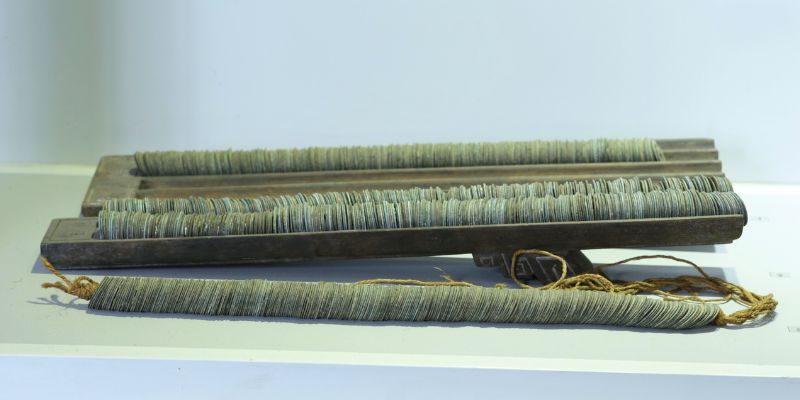
Tool for measuring currency under the reign of Gia Long, witness to the ancient Vietnamese monetary system (Museum of Ho Chi Minh City)
Under the reigns of Gia Long and Thieu Tri, a bronze coin was worth approximately 1.3 times a zinc coin. This distinction testifies to the will to hierarchize metals while ensuring the fluidity of economic exchanges throughout the country.
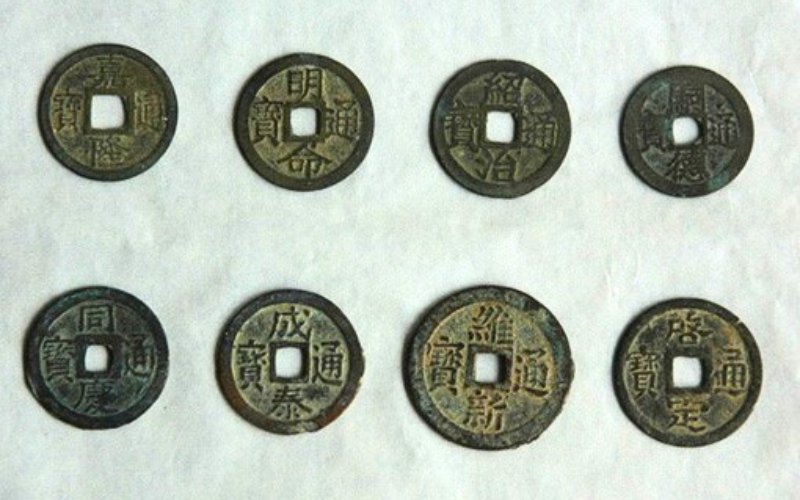
Some currencies bearing the reign names under the Nguyễn dynasty
The Nguyễn emperors furthermore made frequent use of silver and gold ingots, utilized both as a store of value and as a means of payment for important transactions. Special coins, often in precious metals, were minted for honorific purposes and served as royal gifts during great ceremonies.
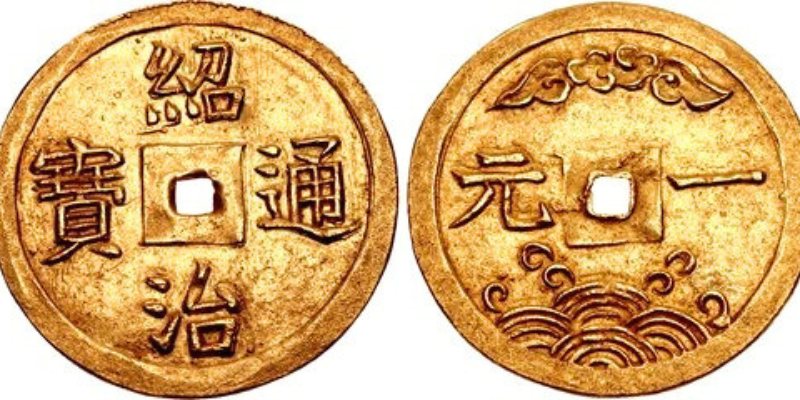
Honorific coin Thieu Tri Thong Bao – Nhat Nguyen, today highly sought after and sold at a high price at auction
To the August Revolution 1945
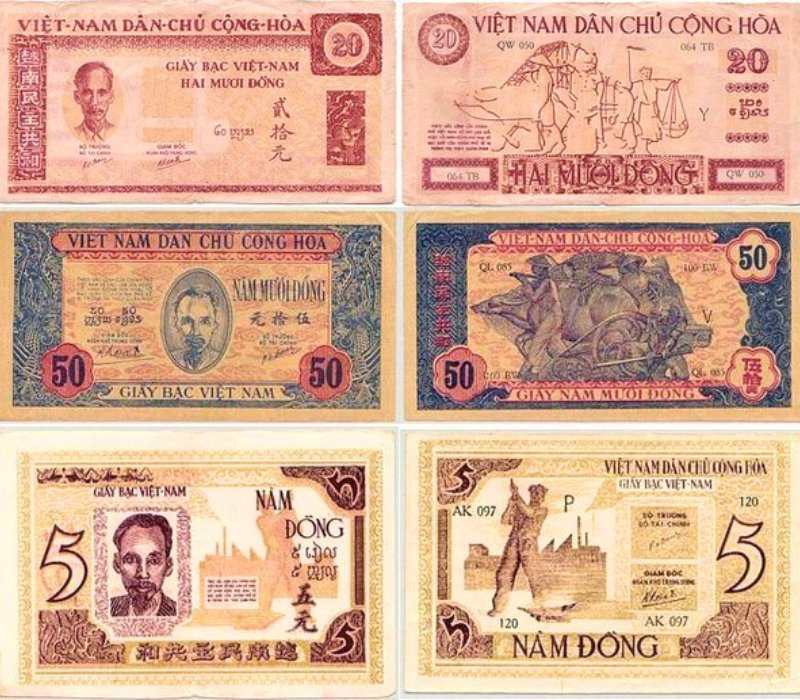
First monetary set of Vietnam (1946–1951), issued by the Ministry of Finance before the creation of the State Bank, called the “Treasury series”
The August Revolution 1945 marked a decisive turning point in the history of modern Vietnam. With the proclamation of the Democratic Republic of Vietnam, officially established on January 31, 1946, the young independent State issued for the first time a national currency: the dong. This new Vietnamese currency symbolized the sovereignty regained by the country after centuries of foreign domination.
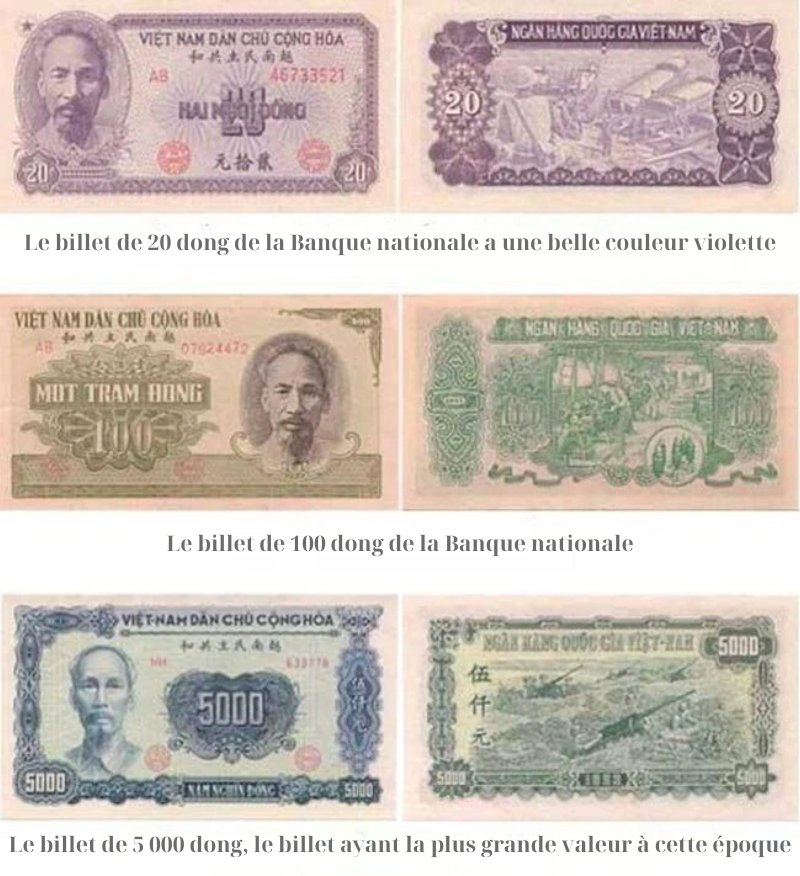
Second monetary series of Vietnam (1951–1958), called the “51 series,” issued after the creation of the National Bank of Vietnam
The first banknotes bore inscriptions in quoc ngu (Latinized Vietnamese alphabet), but also in Chinese, Arabic, Cambodian, and Laotian characters — a choice that reflected the cultural and linguistic diversity of Indochina at that time. These first dong banknotes are today considered true historical witnesses, illustrating at the same time the patriotism, national unity, and the rebirth of a free Vietnam under the direction of President Ho Chi Minh.
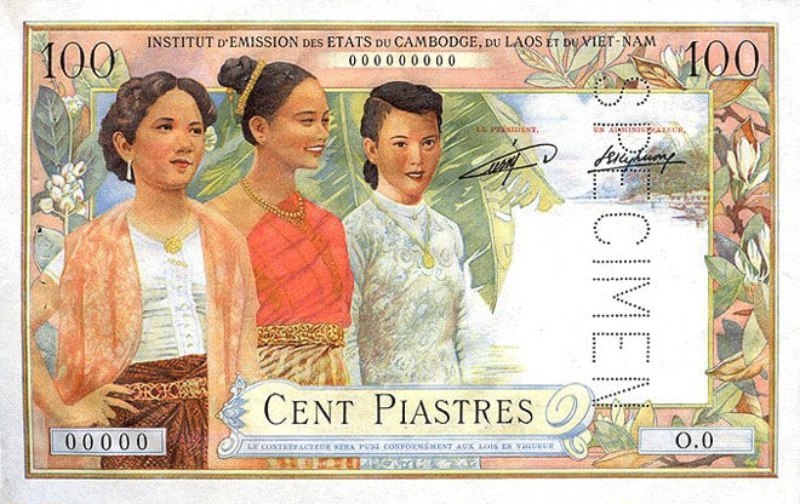
Indochina banknote of 100 piastres, issued by France between 1885 and 1954, depicting three young women from Laos, Cambodia, and Vietnam
Between 1954 and 1975
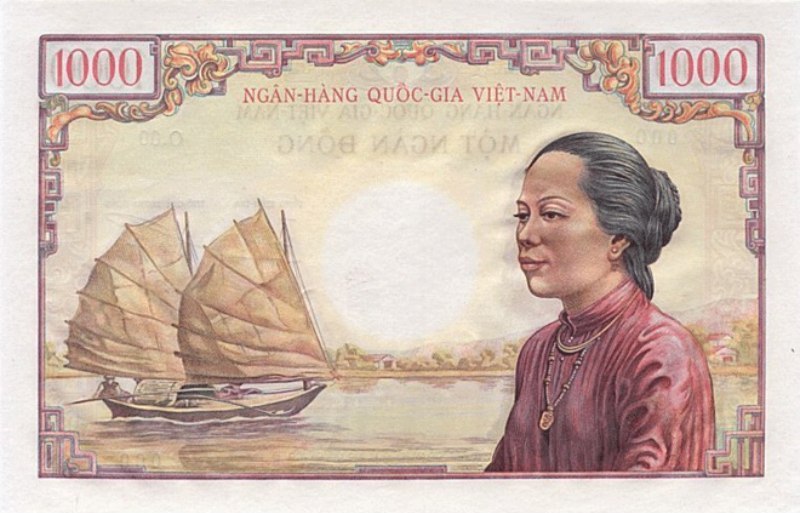
Banknote of the Republic of Vietnam (1954–1975), era when the North and South each had their own “đồng”
The period between 1954 and 1975 constitutes one of the most complex chapters of Vietnamese monetary history. Following the Geneva Accords, the country was divided into two distinct political zones: the North, governed by the Democratic Republic of Vietnam, and the South, directed by the Republic of Vietnam. Each issued its own national currency, both called đồng, but reflecting two opposite economic and ideological orientations.
The North Vietnamese dong
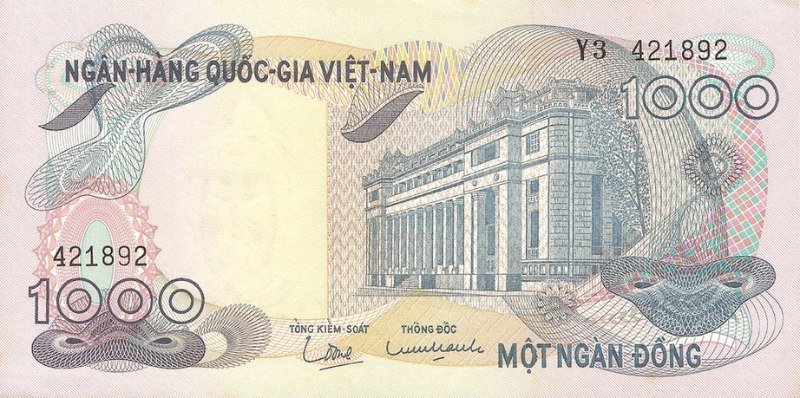
In the North, the State Bank of the Democratic Republic of Vietnam issued the North Vietnamese dong. This currency played an essential role within the framework of the planned economy implemented by the socialist government. It served to regulate internal exchanges, to finance the reconstruction of the country after the war of independence, and to strengthen the economic autonomy of the Ho Chi Minh regime. The North’s dong thus symbolized political stability and national resistance.
The South Vietnamese dong
In the South, the Republic of Vietnam introduced its own currency as early as 1953, in a context of a market economy supported by Western powers. Various coins and banknotes were issued in the years that followed:
- 10, 20, and 50 xu (1953);
- 1 dong (1960);
- 10 dong (1964);
- 5 dong (1966);
- 20 dong (1968).
In 1975, coins of 50 dong were minted but could never be put into circulation due to the fall of the Saigon regime. The South Vietnamese dong reflected a liberal economy, more oriented toward foreign trade and investment, in contrast with the socialist model of the North.
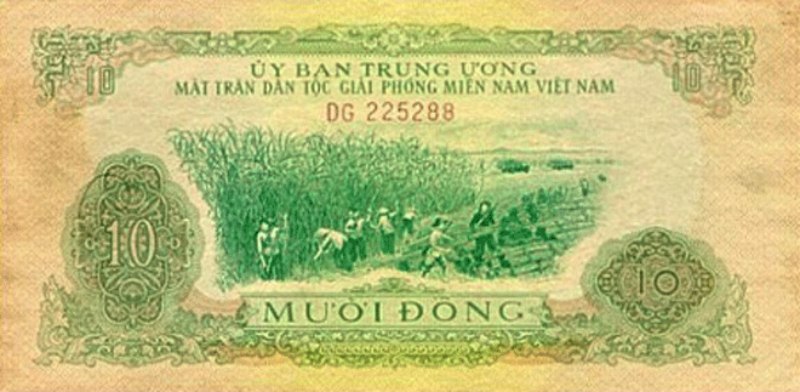
Banknote of 10 đồng issued by the National Liberation Front of South Vietnam, period of the Republic of Vietnam (1954–1975)
Between 1954 and 1975, this coexistence of two currencies bore the mark of the political and economic division of Vietnam. But beyond this rupture, the maintenance of the name “dong” in both systems translated a common cultural and historical bond, deeply rooted in national identity. The reunification of Vietnam in 1975 ended this duality: a single unified dong came into being, marking the beginning of a new monetary era.
From 1975
On April 30, 1975, with the reunification of Vietnam, the political and economic division of the country came to an end. Since then, there was no longer but a single Vietnamese State, and the currency of the South was progressively converted into unified national currency: the dong. An important monetary reform was carried out in 1978, marking the first stage of the standardization of the financial system of reunified Vietnam. A third issue took place in March 1986, introducing new banknotes of 10, 20, and 50 đồng, in a context of economic opening and transition toward the policy of Đổi Mới (renewal). These reforms aimed to stabilize the national economy after decades of war and to lay the foundations of a modern and unified monetary system.
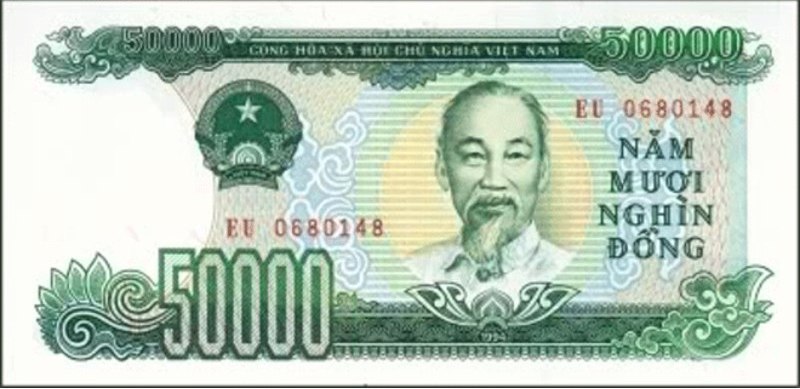
Banknote of 50,000 đồng, put into circulation on October 15, 1994, marking a new stage in the monetary evolution of Vietnam
At the beginning of the 1990s, Vietnamese currency entered a new phase of modernization. Banknotes made of cotton were issued, including:
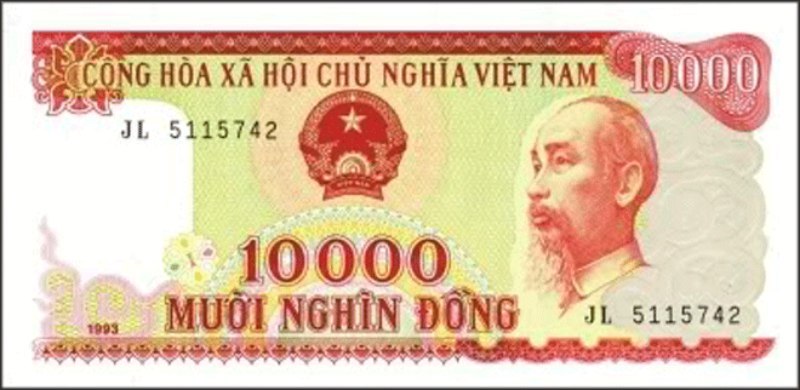
- 10,000 dong and 20,000 dong in 1990,
- 50,000 dong in 1994,
- 100,000 dong in 2000.
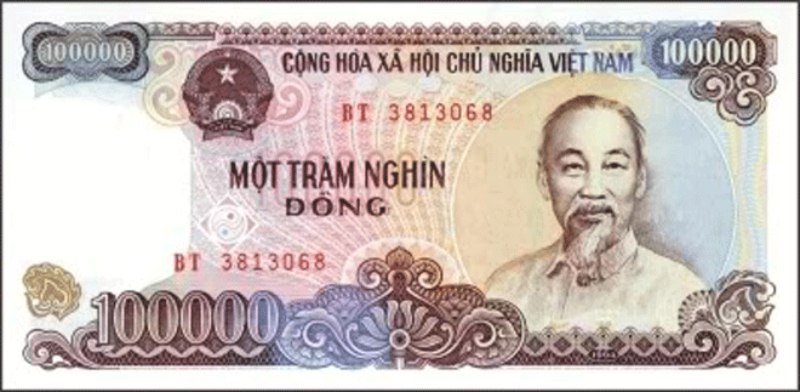
Banknote of 100,000 đồng, the highest value of the era, issued on September 1, 2000
These denominations accompanied the rise of the Vietnamese economy, in full expansion after the reforms of Đổi Mới. Shortly thereafter, Vietnam adopted polymer banknotes, a material more resistant to moisture and wear, perfectly suited to the tropical climate of the country. This innovation, officially introduced from 2003 onward, marked a decisive turning point in the modernization of the national currency.
The new denominations included:
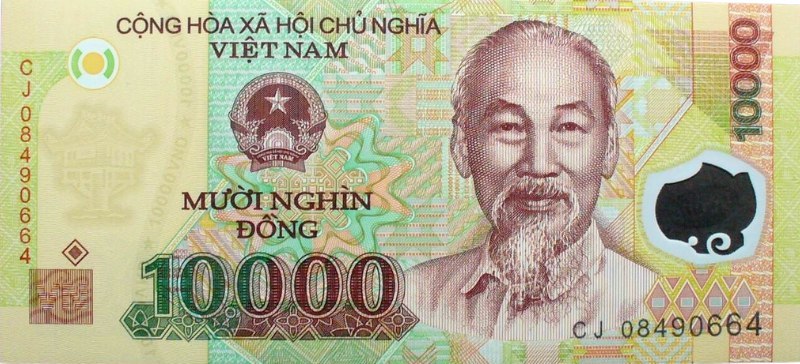
Polymer banknote of 10,000 đồng contemporary
- 10,000 dong and 20,000 dong (2003),
- 50,000 dong (2004),
- 100,000 dong (2004),
- 200,000 dong (2006),
- 500,000 dong (2003, generalized in 2006), today the highest face value in circulation.
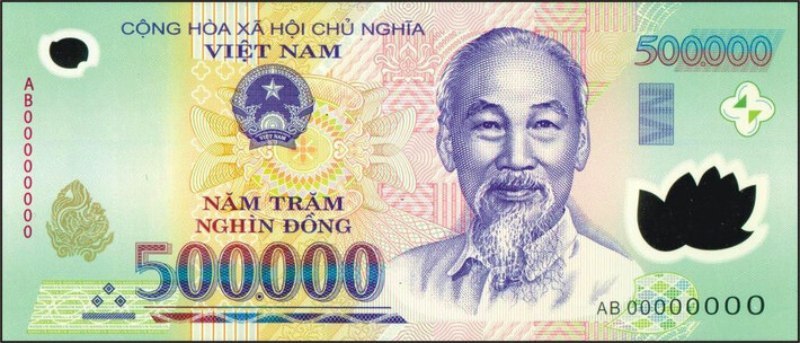
Banknote of 500,000 đồng in polymer, the largest denomination in circulation in Vietnam today
This emblematic banknote, adorned with the portrait of President Ho Chi Minh and landscapes of his birthplace in Nghe An, symbolizes the stability, modernity, and prosperity of contemporary Vietnam. The polymer banknotes currently used testify to Vietnam’s desire to combine technological innovation and cultural heritage. They recall the long evolution of Vietnamese currency, from bronze to paper, then to polymer, in the image of a country in constant transformation yet faithful to its identity.
Ancient Vietnamese currency is a precious heritage, bearing witness to the imperial dynasties, commercial exchanges, and cultural influences that shaped Vietnam over time. More than simple means of exchange, these coins and banknotes tell a story in which art, power, and traditions interweave. Discovering them, one perceives the traces of the past and the ingenuity of a people who has known how to preserve its identity through the centuries. It is a historical treasure that connects Vietnam of yesterday to the living culture of today.