+84 9 75 46 33 10 (Whatsapp)
  info@horizon-vietnamtravel.com
  Français
  Español
  Português
  Deutsch

The Vietnamese Village
Table of contents
The Vietnamese village is very important. Most Vietnamese live in villages, some Vietnamese villages form a commune. More communes make up a larger village. The Vietnamese, from generation to generation, is attached to his village, with a special love for his birthplace. For this reason, a distinction is made between the indigenous population and the resident population. A person from another village who settles in our village is not welcomed favorably. He is judged as an immigrant by the resident population, and has no right to participate in the communal activities of the village.
This distinction is intended to maintain the stability of the villages. At the administrative level of the Vietnamese village, starting at age 18, young people must participate in the confirmation ceremony to change class. Subsequently, they are entitled to a plot of communal land to cultivate; the harvests, minus the portion they must pay to the commune, belong to them and constitute a significant income.
The supreme honor of a member of the giap (the age starting from 18 years) is to rise to the rank of elder. Usually, one enters the category of elders at 60 years old. Becoming an elder means occupying a place of honor on the high mat placed. The class of elders is honored by the entire village. Among mountain communities that have practically not been influenced by Chinese culture, from imperial times; the gia lang (village elders), and hoi dong gia lang, Council of village elders, have retained power. In the regions of the Viet (in the delta), where real powers in the village were transferred to younger classes; the tradition of respecting elders has always been maintained. Respect your elders and you will become old, says the Vietnamese proverb.
Hierarchy in the village
In formal meetings, the elders are placed on the same rank as the Tu Tai (bachelors), the seventy-year-olds, next to the Cu Nhan (university graduates) and the eighty-year-olds with the Tien Si (doctors).
- The population chinh Cu (indigenous or native) in the Vietnamese village is divided into 5 categories:
- Chuc sac (honored graduates), comprising graduates from competitions or distinguished by the king.
- Chuc dich (honored administrators), comprising people who have defined functions in the basic administrative apparatus.
- Lao (elders) comprising all elderly people of the village.
- Dinh (active), comprising men in the prime of life starting at age 18
- Ti au (Little ones), children of the village.
The first two categories and part of the third comprising the oldest, form a body called village notables. These are in turn divided into great notables, administrative notables, elderly notables. The notables comprise the oldest people in the village and play an advisory role to the Council of Notables.
Thus, in direct relation with the population, and at the head of the li dich; there is the li truong (chief administrator) or xa truong (village chief) ; under his orders: Pho li (assistant administrator), the huong truong (who is responsible for security). There are also the so dinh (population register), the so dien (land register) ; one to control the work (able-bodied men), and the other for the economy (rice paddies and land).
The spirit of autonomy
The spirit of autonomy of Vietnamese villages is so high that it is an obvious fact in the face of which feudal and colonial state declare themselves powerless. Peasant communes are like a small kingdom, with their own laws that the villages call Huong Uoc (village conventions) ; and their own small Court (where the legislative body and the administrators of the village constitute the executive body.
In some villages, to imitate the Court, there are four pillars. The pillars represent the four main mandarins of the Supreme Court. The tradition Phep vua thua le lang (the law of the king yields to the customs of the village) is an illustration of the democratic relations between the feudal state and Vietnamese communes.
The characteristics of the Vietnamese village
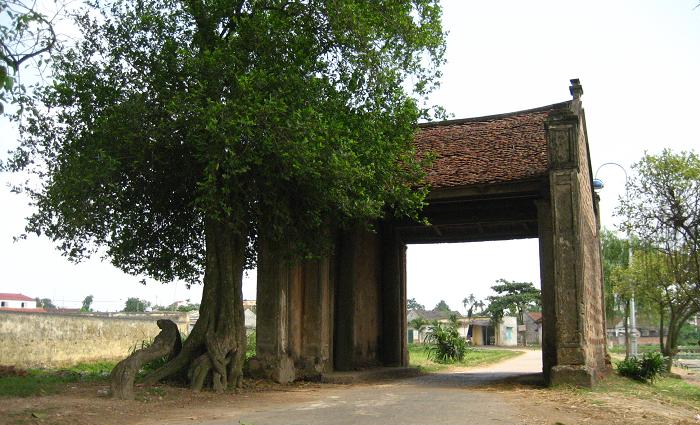
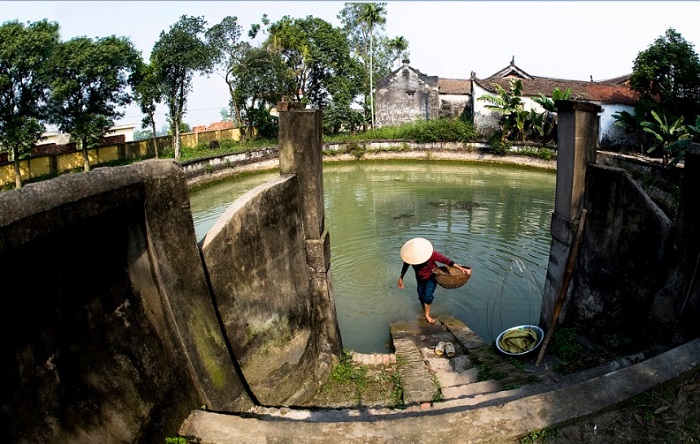
In villages, there are traditional symbols of the community character that are: the courtyard of the communal house, the edge of the public water point — the large banyan tree of the village.
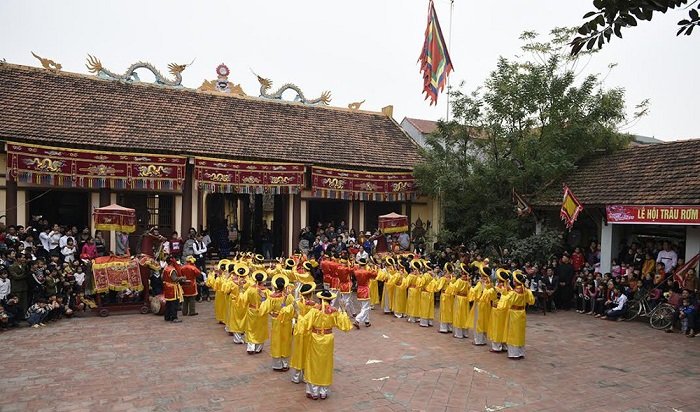
The dinh, the communal house of the Vietnamese village
It is an administrative center: all important events of the village take place here. The council of notables and that of administrators are held here. Taxes are collected here. It serves as a residence for great mandarins and dignitaries who come on inspection or visit. Courts are held here to judge the accused, and those convicted are held in pre-trial detention. It is also the cultural center: all the festivals and ceremonies of the village take place here. During festivals, in the courtyard, theatrical performances are organized, it is also a center of worship. The construction of the communal house obeys strict geomantic constraints since the position of the land and the orientation of the house are thought to be responsible for the destiny of the entire commune. It is here that the cult of Thanh Hoang (tutelary genius of the village) is maintained.
The communal well of the village
It is located next to the communal house, it is the place where women gather for vegetable cleaning, rice washing… The communal well has become the typical symbol of the woman. So much so that in cases of hatred between two villages, a curse is cast on the well of the enemy village. For this reason, a pole is planted in the middle!
The presence of the banyan in the Vietnamese village
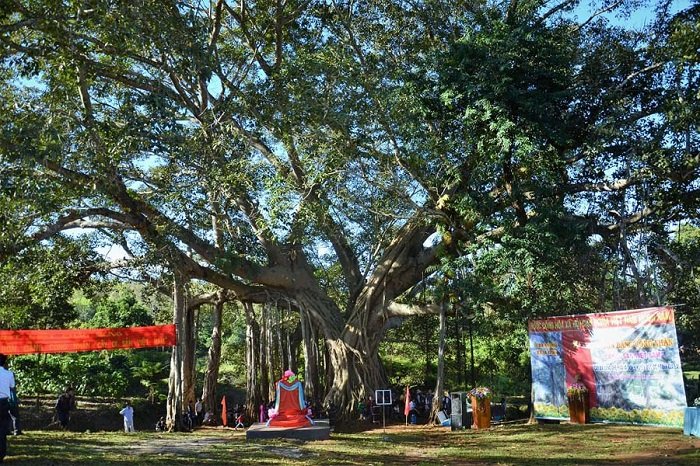
In Vietnam, the centuries-old banyan at the entrance of the village with a small altar at its feet continuously smoked by incense sticks is a sacred place. It is there that geniuses or spirits gather (the spirits are in the banyan, the ghosts in the kapok, owls and foxes in the ficus, says the proverb), if you respect the banyan, it is because you fear the spirit that resides in it). At the foot of the banyan, there is often a small tavern, a place where sometimes farmers rest during field work, or travelers. Thanks to passersby, the foot of the banyan has become a kind of window that allows the village to look toward the outside world.
The bamboo hedge
The wall surrounds the village and becomes a kind of solid, inviolable bastion, indestructible by fire, impossible to cross, with roots that prevent digging underground tunnels. The row of bamboo is an important feature that makes the difference between villages in the south and Chinese fortified farms surrounded by earthen bastions.
The village in South Vietnam
A little history of the Vietnamese village
Under the Nguyen dynasty, the exploitation of the Southern plains brought a new face to the Vietnamese countryside. In the South, the countryside also organizes itself in villages, but while the villages of the North remain well closed behind the bamboo hedge, the main characteristic of the villages of the South is openness.
Here, you don’t see a bamboo hedge all around, with a gate that opens in the morning and closes in the evening as in the North. Homes are scattered, along roads or waterways, in places where life seems easier to them. Their villages are not subject to strict institutions and most of them do not have their own Huong Uoc (internal regulations). The Thanh Hoang (tutelary genius) thus becomes a more or less vague notion.
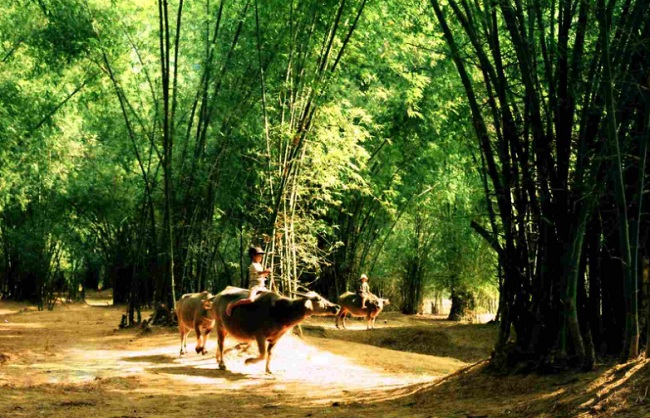
Bamboo hedge of the Vietnamese village
Characteristics of the Vietnamese village
In the South, hamlets and farms are established along canals and streams. The population of the South Vietnamese village is often transient. The farmer is not tied to the land as in the villages of northern Vietnam. This also gives the farmer of the South a more carefree character: one can spend all that one has earned, gradually, without worrying about the rest. This mentality is clearly reflected in a popular song of the South: on the path of adventure, if you see a flock of ducks, you take them away, if the opportunity to marry presents itself, you take it, if you are invited to become a monk, you do not refuse.
All these differences have their reasons, the population is transient because here. Many arable lands have not yet been exploited. One can easily leave one’s village to clear other, less difficult land. If you offer the people of the South to change their habitat area, they are ready. A family leaves easily, preceded by its herd of buffalo. A few personal belongings in a small cart or in a boat. And everywhere you can find land to cultivate and wood to build a house. They do not worry much about the housing problem. However, even if transient, the population of the South always organizes itself into villages. In the shade of bamboo, every Vietnamese village has its communal house with its cult of the tutelary genius, and people always gather on the occasion of annual festivals and ceremonies.